Loading page heading placeholder text
Loading page description placeholder text that holds roughly one line.
TASC helps UAE businesses assess manual processes, develop AI agents and plan how people work alongside them. Start with a time-consuming task and a result you can measure.
A growing queue, repeated checks or too many handovers: identify the source of the delay before deciding what to automate.
Map the task from request to completion. Remove duplicate checks and clarify ownership before introducing an agent.
Find the unnecessary work: Map the task from request to completion. Remove duplicate checks and clarify ownership before introducing an agent.
Explore the process, develop an agent or redesign how your team works alongside AI.

Decide where AI is worth pursuing and what a first project would require.

Develop an agent to carry out a defined task using the information and tools it is permitted to access.

Work out how people and AI share the workload, including the skills and oversight the process needs.
Each stage answers a practical question before the work moves forward.
Look for repeated tasks with usable data, clear rules and someone accountable for the result. These are possible starting points.
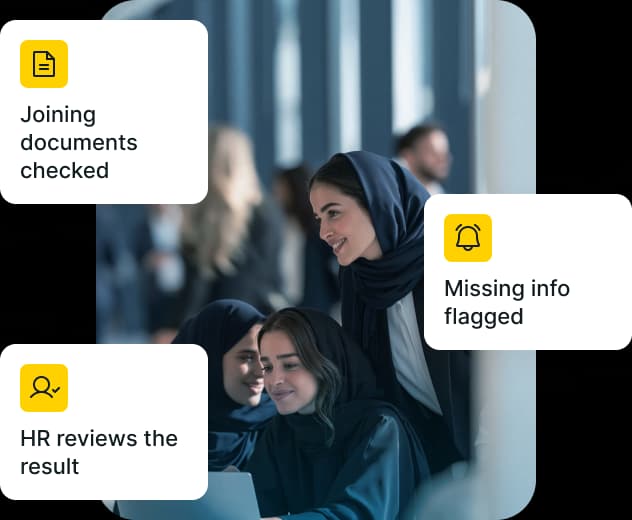
TASC’s AIDA chatbot supports associates. An onboarding project could check joining documents and flag missing information for HR.
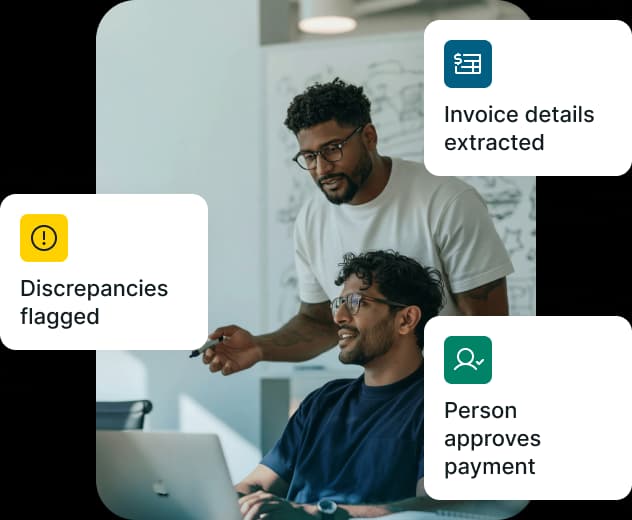
Extract invoice details and flag discrepancies for review before a person approves payment.
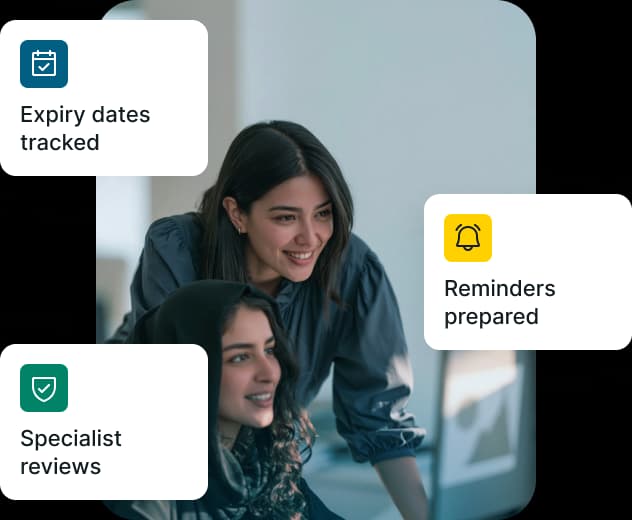
Track expiry dates, prepare reminders and route records for review by the responsible specialist.
Compare applications with agreed role criteria and prepare summaries for a recruiter to assess.
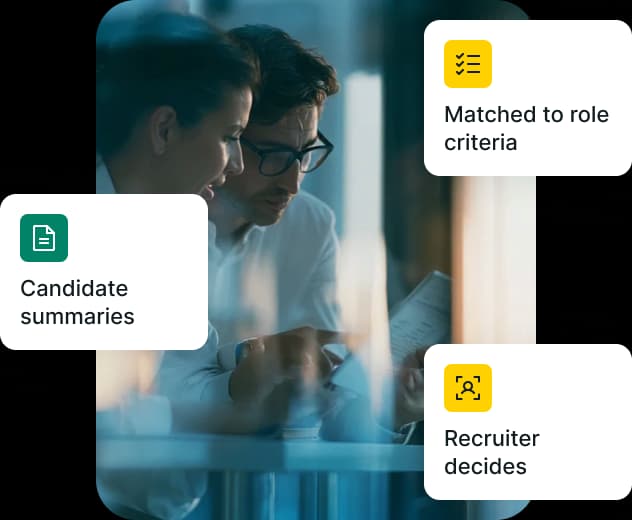
Draft answers from approved information and pass sensitive or unfamiliar requests to a person.

Classify incoming requests and prepare updates for connected systems, subject to access and approval rules.
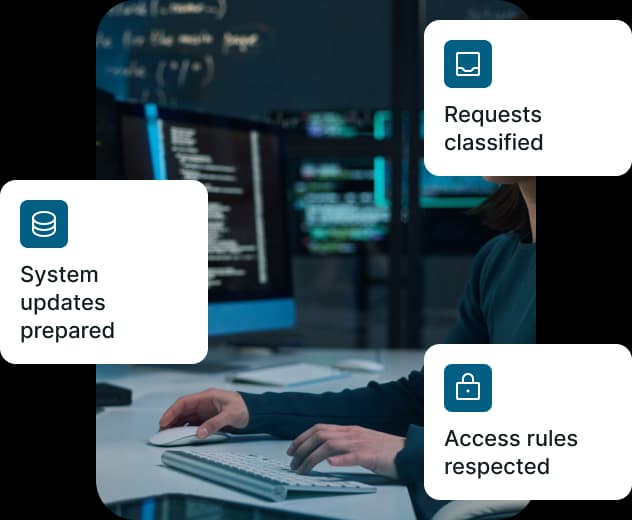
Agree the responsibilities and controls for your use case before deployment.
Data location
Identify where information will be stored and processed. Check retention and cross-border requirements for the proposed deployment.
Access and permissions
Define which records and tools the agent needs. Agree who can grant, review and withdraw access.
Audit trail
Specify which actions and approvals must be recorded, who can inspect them and how long records are retained.
Model and training policy
Review the selected provider’s terms and settings. Agree how business data may be used, including any model training.

TASC works across recruitment, payroll and employee support. That operational context helps frame the questions an AI project needs to answer.
TASC uses AI to support candidate sourcing and screening in its own operations. It is a relevant starting point for discussing where recruitment administration can improve and where a recruiter needs to intervene.
Explore practical perspectives on AI adoption, workforce change and implementation.

9 October 2026
Artificial Intelligence is reshaping the workplace landscape. This article discusses the potential impacts of AI on job roles and how companies can prepare for this technological shift. How AI Is Changing Roles AI tools are automating repetitive tasks such as data entry, scheduling, and first-line customer queries. Rather than replacing people outright, they are shifting the focus of many roles toward analysis, judgement, and relationship management. Preparing Your Organization Map tasks, not jobs: Identify which activities can be automated and which need human input. Invest in training: Help employees build digital and data skills to work alongside AI tools. Set clear guidelines: Define responsible-use policies covering data privacy and accuracy. New Roles Are Emerging Demand is growing for AI specialists, prompt engineers, and data governance professionals. Companies that combine upskilling with targeted hiring will be best placed to benefit from the technology. 45%Faster time-to-hire 60Associates deployed in six weeks 100%Offer-acceptance rate

9 October 2026
Modern manufacturing facilities look entirely different today than they did a few years ago. Production has shifted away from purely manual labor toward automation, robotics, and complex digital systems. While this advanced technology improves output potential, it has created a significant challenge: a severe shortage of qualified workers capable of operating and maintaining these systems. When a factory floor lacks the right personnel, the entire business is affected. A talent gap is not just an administrative problem; it directly compromises daily production efficiency, increases operational costs, and hinders long-term growth. Production Efficiency When a manufacturing line operates without a full team, or when workers lack specific technical training, daily output drops immediately. Machinery can only perform as efficiently as the professionals who manage it. This loss of efficiency typically appears in three major areas: Increased Downtime: High-tech equipment requires strict preventive maintenance. Without skilled technicians on-site, small mechanical issues quickly escalate into major breakdowns, leaving entire lines idle. Higher Error Rates: Overworking existing staff or placing them in roles beyond their current training leads to mistakes. This results in defective products, wasted raw materials, and costly rework. Longer Lead Times: Missing assembly operators or shift supervisors means orders take longer to complete, creating operational backlogs that disrupt the shipping schedule. The table below outlines how an understaffed floor compares directly to a fully optimized facility: Operational Area Fully Staffed Facility Understaffed Facility Machine Up-Time Routine maintenance checks prevent sudden stops. Frequent unexpected breakdowns from delayed care. Quality Control Low defect rates due to thorough testing. Higher error rates due to rush and worker fatigue. Overtime Expenses Labor costs remain within standard budgets. Skyrocketing overtime pay to meet baseline goals. Business Growth The consequences of a talent shortage quickly extend beyond the factory floor to impact broader business goals. Consistent and predictable production is essential for company growth. First, inconsistent output strains client relationships. Missing delivery deadlines due to understaffed lines damages trust with distributors and retailers, who may eventually look for more reliable suppliers. Second, a talent gap limits a company's ability to scale. If a business wins a major new contract but lacks the engineers or operators to handle the increased volume, it must turn the opportunity down. Finally, without skilled staff, adopting new technologies to cut operational costs and remain competitive becomes impossible. Supply Chain Coordination Manufacturing does not operate in isolation. It relies on a balanced cycle of incoming raw materials and outgoing finished goods. When production slows down due to a lack of staff, it creates a disruptive domino effect across the entire supply chain. If a production line falls behind schedule, delivery trucks sit empty, warehouse inventory becomes disorganized, and distribution networks stall. This is why industrial operations must coordinate their factory hiring with strategic logistics recruitment plans. Keeping warehouse, transport, and production teams balanced is the only way to prevent costly bottlenecks between the facility and the customer. Sourcing Solutions Finding specialized technical talent for modern industrial roles is highly complex. Standard job boards rarely attract candidates with the precise certifications and machinery experience required for high-tech production. Internal HR teams are often occupied with daily administrative tasks and onboarding, leaving little time to actively source niche engineering talent. To resolve these shortages quickly, companies frequently partner with a specialized manufacturing recruitment agency. An experienced agency maintains an active database of vetted professionals, from plant managers to automation technicians. They know how to verify technical credentials and access passive candidates who are open to the right career move, reducing hiring times and protecting production schedules. Partner With TASC Outsourcing to Manage Manufacturing Talent Gap Managing workforce shortages on the factory floor requires a proactive strategy and strong market insights. At TASC Outsourcing, an experienced manufacturing recruitment agency, we help industrial businesses locate and secure the highly skilled technical talent needed to sustain production. Whether you need permanent automation engineers or flexible contract staff to handle busy production cycles, we manage the entire process from technical vetting to local compliance. Contact TASC Outsourcing UAE today to learn how our workforce solutions can protect your operational efficiency and support your business growth.

9 October 2026
In today's interconnected world, effective networking is crucial for professional growth. This guide outlines strategies for building a robust professional network. Start With Clear Goals Decide what you want from your network, whether that is finding a mentor, exploring a new industry, or growing your client base. Clear goals help you focus your time on the right people and events. Practical Networking Strategies Be active online: Keep your professional profile current and share useful insights in your field. Attend industry events: Conferences, trade shows, and meetups are great places to meet peers. Give before you ask: Offer help, introductions, or advice to build trust. Follow up: A short message after a meeting keeps the connection alive. Maintain Your Network Strong networks are built over time. Check in with contacts regularly, celebrate their successes, and stay open to new connections throughout your career.

9 October 2026
As remote work continues to gain traction globally, companies in the MENA region are adapting to this trend. Our latest study explores how businesses are restructuring to offer flexible work models while maintaining productivity, compliance, and a strong company culture. A Shift in Workplace Expectations Professionals across the UAE, Saudi Arabia, and the wider Gulf increasingly view flexibility as a core part of the employment package. Employers that offer hybrid or remote options are seeing stronger application volumes and better retention, particularly in technology, consulting, and customer care roles. How Businesses Are Adapting Hybrid schedules: Set office days for collaboration, with focused work done remotely. Digital infrastructure: Investment in secure cloud tools, video conferencing, and performance tracking. Updated policies: Clear guidelines on working hours, data security, and cross-border work. Compliance Considerations Remote work introduces new questions around visas, labour law, and payroll, especially when employees work from another emirate or country. Partnering with an experienced outsourcing provider helps employers stay compliant while giving their teams the flexibility they expect.
Practical answers before you commit to an AI project.
Talk it through with TASC and discuss what a first assessment would involve.
They can support defined tasks such as reviewing documents, preparing responses or moving information between systems. The useful starting point is a process with repeated work and an outcome you can check. TASC can help assess the opportunity and scope the work.
Tell us where work slows down and which team owns it. Discuss what a first AI project would involve, including scope and dependencies.
Phone
+971 4 358 8500
info@tascoutsourcing.com
Location
Dubai, UAE
Response time
Contact us to discuss availability.